D4: Fish Habitat and Passage Improvement*
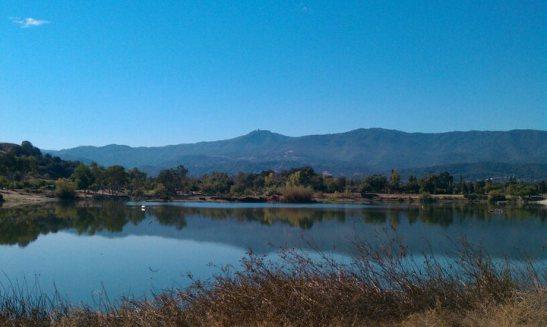
This project helps restore and maintain healthy fish populations, especially steelhead, by improving fish passage and habitat. Sites may include Alamitos Creek at Almaden Lake and County of Santa Clara-owned Ogier Ponds, where human-made creek alterations disrupt fish migration. Project D4, which includes coordinating and partnering with other external parties, incorporates studies of streams throughout the county to determine what and where habitat improvements will most benefit steelhead. These studies can be used by regional partners to implement complementary habitat enhancements.
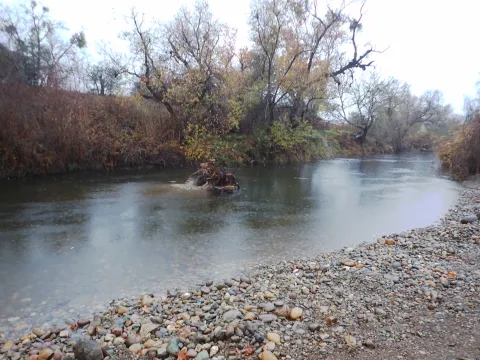
The project also continues funding to place instream gravel, boulders, large wood, or other features to enhance fish habitat at appropriate locations. By adding natural stream features such as large wood, we can create habitat to provide refuge during fish migration, prolonged drought, or extreme rainfall events. Additionally, habitat restoration can improve ecosystem function and increase resiliency to climate change. By restoring natural functions, issues such as water quality may be less exacerbated and native species can continue to flourish and adapt.
See Environmental & Community Benefits section for complete description of Key Performance Indicators (KPIs).
KPI #1: (Planning and design for creek/lake separation)
- On May 11, 2021, the Board certified the Final Environmental Impact Report. Click here to read the report.
- The planning phase of the project was completed in 2019.
- Valley Water closed out the design phase in FY24.
KPI #2: (Partially construct creek/lake separation)
Ogier Ponds: Coyote Creek runs through Ogier Ponds, which are six large, abandoned mining pits. Currently, fish get lost and cannot find their way out of the ponds, leaving them vulnerable to non-native predatory fish and to the ponds’ rising temperatures that can impact fish growth and health. Since 2016, Valley Water and Santa Clara County Department of Parks and Recreation have studied the potential of separating Ogier Ponds from Coyote Creek to improve fish passage. Based on that work, Valley Water decided to include the Ogier Ponds-Coyote Creek Separation Project as part of the Anderson Dam Seismic Retrofit Project (ADSRP) conservation measure.
- A Master License Agreement (MLA) was completed in December 2024 to facilitate Valley Water’s access and planning study investigations on Santa Clara County Parks land.
- Completed the conceptual alternatives and draft feasibility analysis in FY24.
- Completed the Draft Feasible Alternatives Report with regulatory agency review in FY25
- Develop Planning Study Report with the recommended alternative in FY26. Design is expected to begin in FY27.
- Construction will be coordinated with ADSRP completion (currently 2032).
KPI #3: (Fish passage improvements)
Moffett Fish Ladder: In FY23, Valley Water selected the Moffett fish ladder on Stevens Creek for fish passage improvement. A planning study report is being prepared to define problems with the existing structure, present options to improve the structure, receive input from stakeholders, and identify a staff-recommended alternative for design and construction.
This fish barrier is ranked seventh in Valley Water’s fish passage barrier prioritization report for Stevens Creek (Stevens Creek Fish Passage Remediation Prioritization: August 2021). Poor fish passage performance at this facility results from debris clogging in the ladder and poor attraction flows at the entrance. Key milestones include:
- Completed Draft Feasible Alternatives Report in FY25.
- Currently addressing internal comments received for the Draft Feasible Alternatives Analysis Report to determine the Staff Recommended Alternative for the Planning Study Report.
- Design is expected to begin in FY26 with construction expected to start by FY28.
Singleton Road Fish Barrier: In October 2021, the City of San José, in partnership with Valley Water, completed construction of an interim bridge, replacing the previous Singleton Road low-water crossing over Coyote Creek. Valley Water provided $1.0 million in cost-share funding to the city for construction. Valley Water also provided the city with project design services and permitting assistance. The low-water crossing presented a critical barrier to fish passage and its removal has increased migratory fish access to about 17 miles of upstream Coyote Creek riparian corridor including access to the cold-water management zone. Valley Water will continue to monitor project performance through 2031.
KPI #4: (Steelhead stream study update)
In FY25, Valley Water completed the data collection and stream reconnaissance phases of the fish passage barrier removal prioritization study for Guadalupe Creek, Alamitos Creek, and Arroyo Calero. Of the 16 sites originally identified, six (6) were determined to no longer pose a barrier to fish passage. Field assessments also led to the identification of 12 new potential barrier sites. As a result, a total of 22 sites will be further analyzed for fish passage.
The fish passage analysis and assessment phase—consisting of topographic surveys and the development of streamflow models—began in September 2024 and is anticipated to be completed in FY26. The full fish passage barrier prioritization study for all three creeks is expected to conclude by the end of FY26.
KPI #5: (Habitat enhancement projects)
Uvas Creek: In August 2022, Valley Water completed the construction of the large woody debris and gravel augmentation (LWDGA) project to improve the fish habitat along Uvas Creek in Gilroy. The project is designed to increase instream habitat diversity, shelter complexity, and the amount of instream shelter at three sites along Uvas Creek. The design of Site 1, located approximately 1,200 feet downstream of Santa Teresa Boulevard, consisted of an engineered log jam (ELJ) of rootwad logs on the right bank intended to create hydraulic complexity and increase shelter cover and complexity. The ELJs for Sites 2 and 3, located 1,500 feet and 600 feet upstream of Miller Avenue, included a bar apex jam at each site designed to cause channel bifurcation and increase habitat complexity.
Staff is coordinating with the Anderson Dam Tunnel Project (ADTP) team to potentially complete the construction of the Live Oak Restoration Reach, which is a fish habitat enhancement project that is part of the mitigation that is being implemented to offset impacts from the ADTP.
September 2025
For more information:
Creek/Lake Separations
- Almaden Lake: Erin Baker, (408) 630-2608
- Ogier Ponds: Kevin Sibley, (408) 630-3141
Fish Passage Improvements
- Kevin Sibley, (408) 630-3141
Fish Habitat Improvements/Steelhead Stream Study Update
- Steelhead Stream Study: Davis Hernandez-Alvarez, (408) 630-2049
- Habitat Enhancement Projects: Judy Nam, (408) 630-2747